


The BIP at 20!
Building Indicator Project
20 years ago, with a fleet of interns, UNHP manually looked up more than a dozen data points for each of the 7,175 Bronx multifamily buildings and issued our first Building Indicator Project (BIP) database release to multifamily lenders. In 2002-3, Mayor Michael Bloomberg launched Open Data, enabling UNHP to access property records online for the first time. Encouraged by our first releases and the value of data, UNHP contracted LotInfo, a mapping and IT company, to create a custom utility to automatically pull the data. By 2007, UNHP had its first four-borough final report, profiling 58,000 properties. (Staten Island was added in 2013.) Currently, BIP has aggregated more than a decade of data for all 70,000+ rental buildings in NYC, tracking more than 120 data points for each building. BIP also employs a scoring system developed in collaboration with financial institutions, advocates, property managers, and researchers to identify buildings likely or highly likely to be distressed.

Our first multifamily lender roundtable meetings were indeed small enough to fit everyone around a conference table. Starting in 2013, the Multifamily Lenders meetings were held at Enterprise to accommodate a growing number of NYC multifamily lenders and policy makers. UNHP would share the trends in multifamily real estate with a report on distress indicators, Bronx demographics, multifamily sales values, and net operating income. HPD Deputy Commissioners for Development would often attend, providing information on violations and public programs for repairs and renovations. The research and presentation is led by the UNHP “BIP Master”, and Jim Buckley provided an overview and answered the questions raised. UNHP is grateful to our BIP Masters who have each preserved the integrity of the BIP database and expanded our research in meaningful ways: Gregory Jost, VaNessa LaNier, Jacob Udell, and Ana Peña.
Here are some significant points in the Building Indicator Project (BIP) Timeline
2002-3 Mayor Bloomberg makes publicly available property data accessible online through an open data initiative.
2003 – UNHP begins using newly available open data to explore creating a small, searchable database of properties with many characteristics, including violations, liens, and mortgage data.
2004 – UNHP presented housing code and lien data to a group of multifamily lenders and affordable housing stakeholders. UNHP integrated the feedback on indicators to incorporate into the scoring formula, weighing new violations and the dollar amount of liens per unit more heavily than old violations and smaller lien amounts. Read more about the scoring system here.
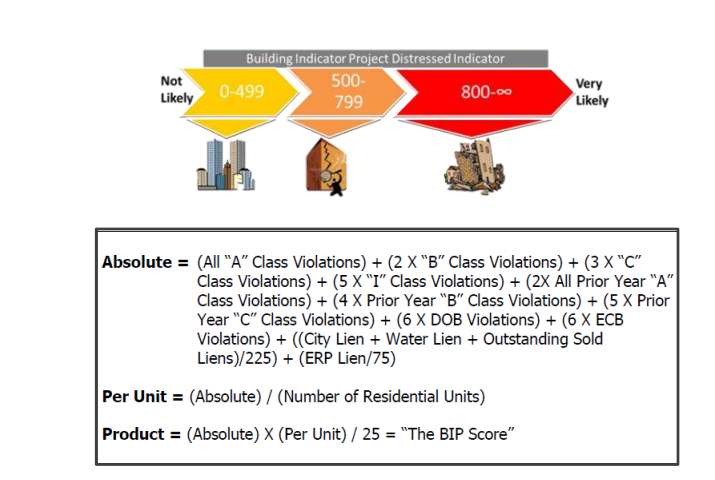
Buildings scoring 500 to 799 are likely to be distressed, and those scoring 800 or more are highly likely to be distressed. The indicators of financial and physical distress, liens, and violations are used in the formula, which was tested over time by physical inspections and shared with groups of lenders and affordable housing stakeholders. Feedback from the group led to greater reliance on recent and more serious violations, and the formula was tweaked to account for the property’s size. Tax, water, ERP, and DOB liens shape the financial distress of properties. The BIP is unique in its access to water and sewer liens as indicators of distress. The rising costs of water and the resulting liens have contributed to the recent increase in distress. Read more about the scoring system here.
20 years ago, in 2006, UNHP brought together a group of multifamily lenders to review the data points for each of the 7,175 Bronx multifamily buildings compiled from open data sources by UNHP interns. The anniversary marks the first Building Indicator Project (BIP) database release to multifamily lenders and the start of annual in-person and virtual meetings with multifamily lenders.
2007 – Engaged mapping and IT company, Lotinfo, to develop a custom utility to reduce manual effort in data compilations, and UNHP was able to share our first four-borough report profiling nearly 58,000 multifamily properties
2013 – The technology is available to add the 526 Staten Island properties to the database. Previous multifamily lender meetings could be accommodated around a conference table. 2013 was the first year that UNHP had to use a larger room to host the growing number of attendees. See the first Multifamily Lender meeting blog here.
In 2013, BIP data helped a Bronx community group bring a reluctant owner to the table and broker a deal between the lender and preservation-minded purchasers to acquire and renovate three distressed buildings with 63 apartments.
In 2014, the NYS Department of Financial Services issued final guidelines outlining that DFS CRA examinations will consider whether a bank has met its responsibility to ensure that a multifamily loan submitted for affordable housing or neighborhood revitalization credit under CRA contributes to, and does not undermine, the availability of affordable housing or neighborhood conditions. UNHP’s BIP is cited in the guidelines as one of the tools for determining whether the property has substandard living conditions. UNHP shares the BIP with all Bank regulators and has had meetings with each to review how the BIP identifies distress in multifamily buildings.
In 2019, over 15 years after the Building Indicator Project (BIP) began, UNHP transitions to an updated database system known as the BIP Server, which allows for easier and more powerful analysis of historical data, as well as automation of key processes within the Building Indicator Project
In 2023, the Building Indicator Project had its “moment.” UNHP’s BIP and its ability to identify the senior lender for multifamily properties pinpointed Signature’s exact portfolio at the time of its collapse. (A flawed record-keeping system for mortgaged properties by Signature Bank made their data incomplete.) UNHP shared that information with the FDIC, electeds, and community organizations. UNHP joined the New York Housing Conference and U.S. Representative Ritchie Torres for a press conference in April of 2023, shortly after the collapse. The FDIC later singled out our early interventions in Signature’s collapse, as “UNHP’s moment” – and sealed our selection by the NY Housing Conference as nonprofit of the year. UNHP remains engaged with the Joint Ventures that were selected by the FDIC to oversee the restructuring and improvement of the distressed properties in the BIP portfolio. Using the BIP as its foundation, UNHP collaborated with JustFix to create the Signature Dashboard, an easy-to-use tool to track progress towards improvement goals for the JV’s, FDIC, HPD, and Tenant groups. In 2023, UNHP, under the direction of Jacob Udell, also launched the Bronx Housing Research Network (BHRN) to expand and deepen our efforts to support tenant leaders and advocates and to advance community organizing through technical assistance that makes our data, research, and community development experiences accessible. UNHP has long been involved in technical assistance and research support for community-led housing initiatives, and the BRHN provides its research, community acquisition experience, and data to tenant organizers, leaders, and advocates to break down and analyze complex multifamily finance issues and engage effectively with landlords, lenders, and regulators.
2024- UNHP selected as Nonprofit of the Year by the New York Housing Conference! The BIP and UNHP’s role in the intervention for the multifamily properties mortgaged by Signature Bank sealed our selection as Nonprofit of the Year.
2025 – UNHP continues to invest in the BIP, updating the server, streamlining the BIP process using a DBT framework, and documenting data sources, codes, and pipelines to preserve the database’s longevity. The UNHP Multifamily Research and Action Center and its tool, the Building Indicator Project, have improved tens of thousands of multifamily units throughout NYC.
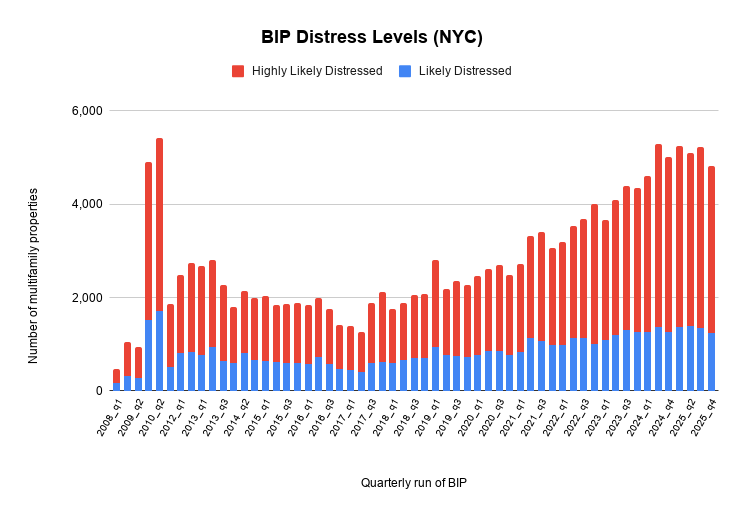
The Multifamily Research and Action Center (MFRAC) is a collaborative effort between University Neighborhood Housing Program (UNHP) and major multifamily lenders, foundations, public agencies, owners, and managers to preserve affordable, quality housing in the Northwest Bronx and other low-income neighborhoods in NYC. UNHP’s primary goal through MFRAC is to improve the living conditions and preserve the long-term affordability of multifamily rental units for low-income NYC households living in distressed housing, with a focus on the Bronx. The Building Indicator Project (BIP) database is the shared tool we use to drive that focus. The database was developed to identify levels of physical and/or financial distress in NYC multifamily rental properties.
The BIP database is updated quarterly and used by various partners, including 62 community organizations and advocacy groups, 7 agencies, 46 financial institutions, and significant bank regulators. Non-profits use BIP to identify distressed buildings in their catchment areas, organize them, build portfolios by landlord or lender, and conduct analysis to support advocacy. Financial institutions use the data to monitor properties in their lending portfolios and hold their borrowers accountable for conditions. During CRA examinations, regulatory bodies review BIP scores for buildings within a bank’s portfolio to ensure that loans meet community needs.

The work of UNHP’s Multifamily Research and Action Center and its tool, the BIP, benefits Bronx and citywide low- and moderate-income (LMI) tenants. As the chart shows, 92% of distressed (800 & Over) buildings are home to low- and moderate-income Bronx tenants. Citywide, 66% of tenants in distressed buildings are LMI. Citywide, over 100,000 LMI households live in distressed buildings.
UNHP collects and shares data, and works with banking and community group partners to offer training, conduct specific research, and create and share information. Additionally, UNHP uses the BIP as a foundation for original research and policy work. One such example is a report titled “Gambling with Homes” or “Investing in Communities,” written in collaboration with the Local Initiatives Support Corporation. This research employed over a decade of BIP data to identify the effects on speculative housing investments on building quality and tenant stability. (BIP research on budget cuts)https://unhp.org/publications/impact-of-proposed-federal-housing-budget-cuts-nyhc-policy-brief-and-wsj-article/
UNHP also works to share our data and research through our newly created Bronx Housing Resource Network with community organizing groups to build capacity to understand multifamily finance, opportunities for community ownership, and other relevant topics. For instance, in the wake of the collapse of Signature Bank, the BIP has played an important role in providing critical information about the 2,300 multifamily buildings with over 70,000 units with a Signature mortgage to the bank regulator, the FDIC, legislators, and community organizations with a stake in the preservation of the units for the long-term and in any future loan disposition plan. UNHP participates in regular meetings with the Joint Venture entities and, working with JustFix, created a Dashboard that is being used by all stakeholders to track progress towards physical improvement and financial stabilization goals for this portfolio.
See below for blogs and reports featuring BIP data: