


2026 Multifamily Lenders Roundtable Meeting Focuses on Operating Costs & Advocacy Efforts
This year, UNHP is celebrating 20 years of the Building Indicator Project (BIP) and, alongside it, 20 years of the annual Multifamily Roundtables. Since 2006, UNHP’s Multifamily Research and Action Center has collaborated with multifamily lenders, foundations, public agencies, owners, and managers in order to preserve the affordability of multifamily properties in the Bronx and throughout NYC. The BIP database is the main tool that UNHP uses to provide credible, well-researched data insights to the affordable housing community. The database is updated quarterly and shared with interested parties and community partners. In addition to general quarterly updates, UNHP hosts an annual Multifamily Lenders Roundtable to share important data points with lenders who have multifamily properties in their portfolios. Our most recent Roundtable held on August 5th, 2026, was attended by over 50 individuals representing 16 different lenders and 4 multifamily preservation interests; we were also honored to be joined by HPD Commissioner Dina Levy. The presentations shared by UNHP and HPD at the meeting, with additional data and information, can be found here.

UNHP’s Community Researcher and Data Analyst, Ana Peña, at “UNHP BIP Central.” This past year, UNHP has been working to ensure BIP’s long-term preservation and accuracy. The agenda for the 8/5 meeting covered data analytics, a look at operating cost drivers and recommendations, details on how the BIP can be used by lenders to monitor and intervene on physical and financial distress, and an explanation of how the BIP data is collected.
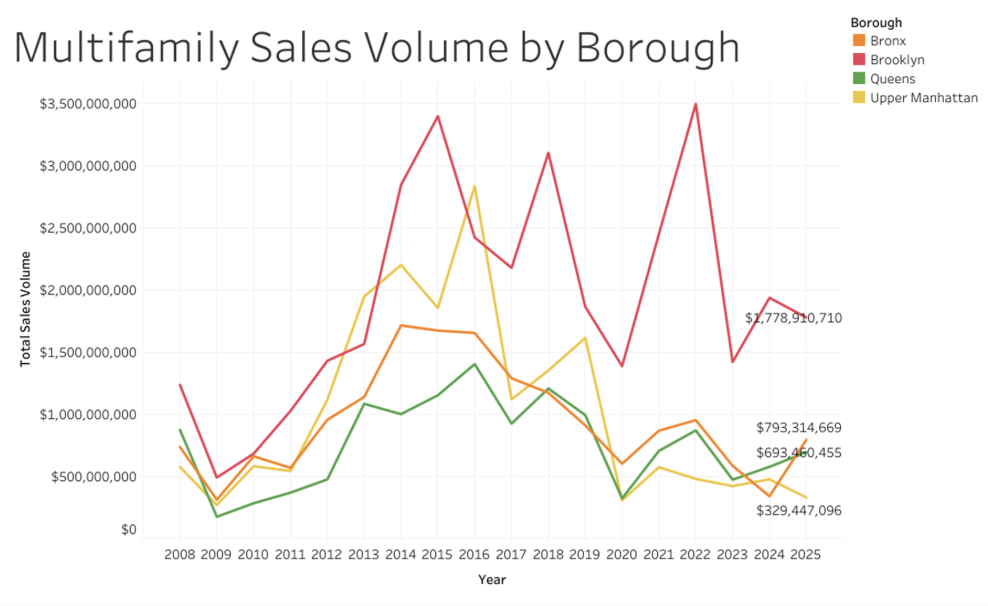
Ana Peña started off the meeting with an overview of sales data across the Bronx, Brooklyn, Queens, and Upper Manhattan. For relevance and legibility, core Manhattan data was left out —this includes anything below 110th Street. Overall, multifamily sales volume, which depicts the sum of all recorded sales for each year, has been trending downward in recent years. This is likely due to increases in interest rates and increased market skepticism. Going against the grain, both the Bronx and Queens actually saw an increase in sales volume between 2024 and 2025.
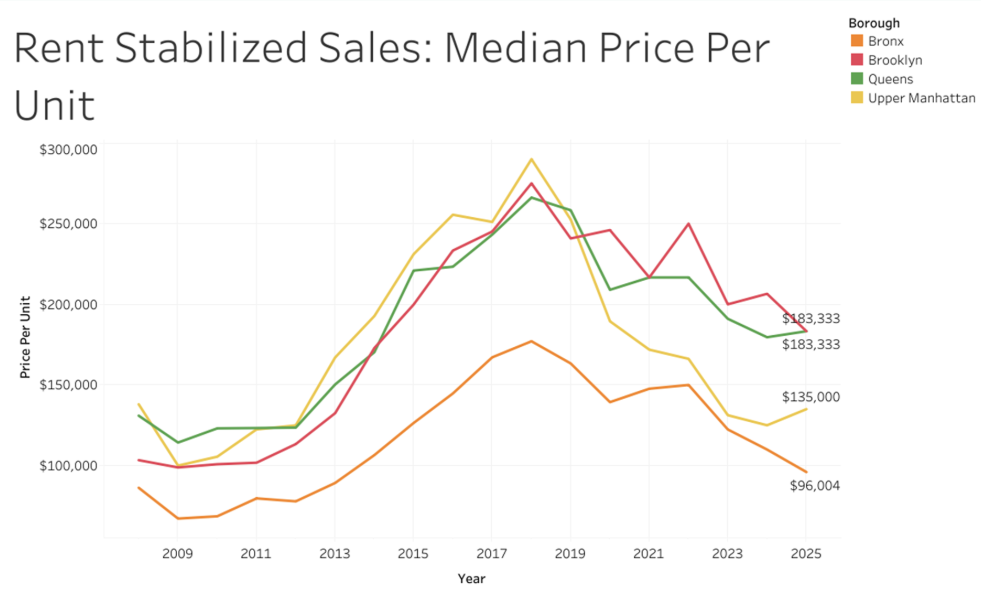
UNHP also tracked average price per unit for market-rate and rent-stabilized units across boroughs and found a downward trend in average price per unit, with the exception of Brooklyn. Zooming in specifically to rent-stabilized units, UNHP found that the median price per unit was lower than that of market-rate units. The Bronx also clearly has the lowest price per unit with the median price sitting at around $96K while the second lowest price per unit in Upper Manhattan is $135K.
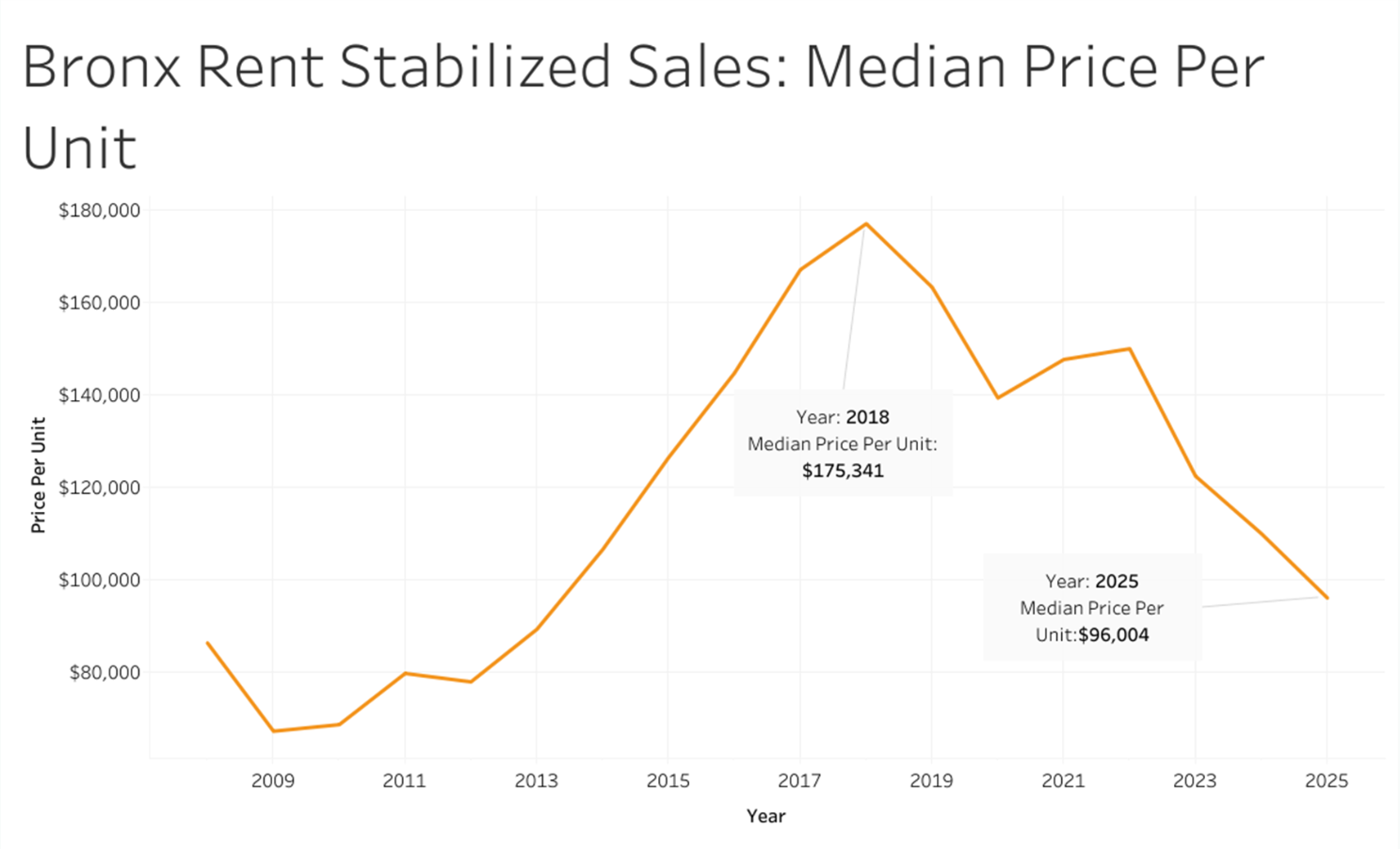
Looking more closely at UNHP’s direct catchment area, we see the marked fall in the median price per unit for rent-stabilized units in the Bronx. The median price per unit peaked in 2018 at around $175K and has since decreased 45% in value to just $96K.
Brendan Mitchell, UNHP’s Director of Real Estate, focused on operating costs, such as rising insurance costs and water and utility rates in UNHP’s affordable multifamily portfolio. Rising property and liability insurance costs, utility costs, maintenance expenses, and local law compliance place financial strain on operators and force them to make difficult financial decisions. As we have detailed in previous blog posts, more and more affordable multifamily properties are in the red, meaning operating costs are exceeding rent collections. This leaves no surplus that allows operators to invest in retrofitting and building maintenance.
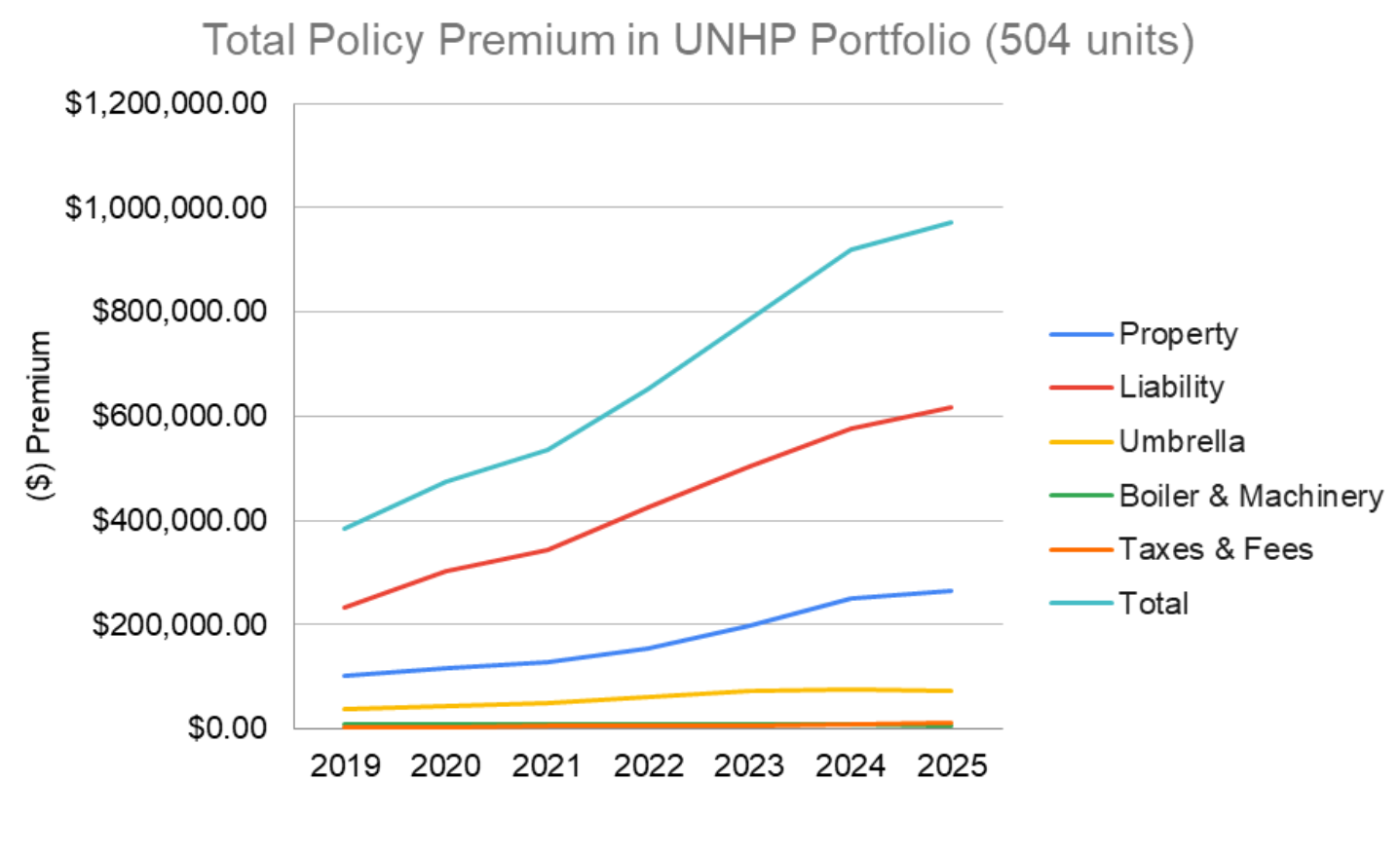
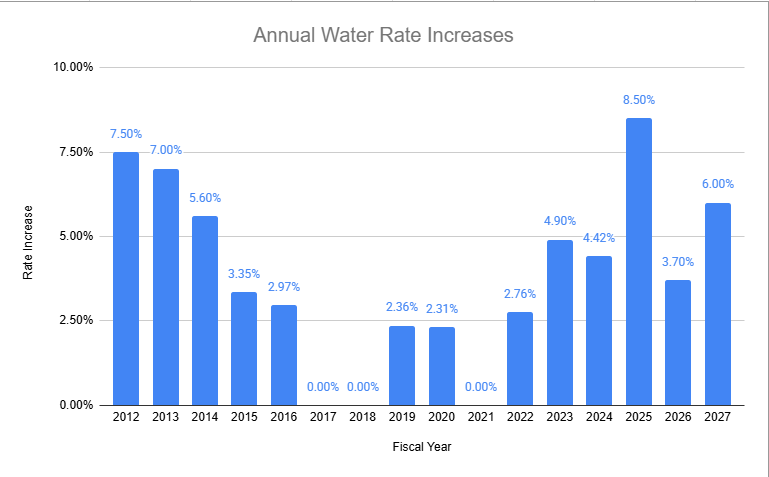
Brendan further detailed these challenges, joking that insurance is the most common complaint heard at housing conferences across NYC. Across UNHP’s portfolio alone, total policy premium costs have risen from just below $400,000 in 2019 to almost $1,000,000 in 2025. (chart below) This translates to just under $800 per unit in 2019 to nearly $2,000 per unit today. On top of skyrocketing insurance costs, water and sewer rates continue to climb. UNHP has been at the forefront of advocating for lower water and utility costs and continues to oppose rate hikes. Executive Director Jim Buckley testified at the New York City Water Board hearing in June to oppose the proposed rate hike for FY 2027. Since 2022, City water rates have consistently increased, with the latest 6% increase approved for 2027. (Chart below). UNHP is encouraged by the City’s efforts to expand the Multifamily Water Assistance Program to offer discounted water rates to up to 75,000 units for FY 2026 and 2027, and is calling for more relief for multifamily housing serving lower-income households.
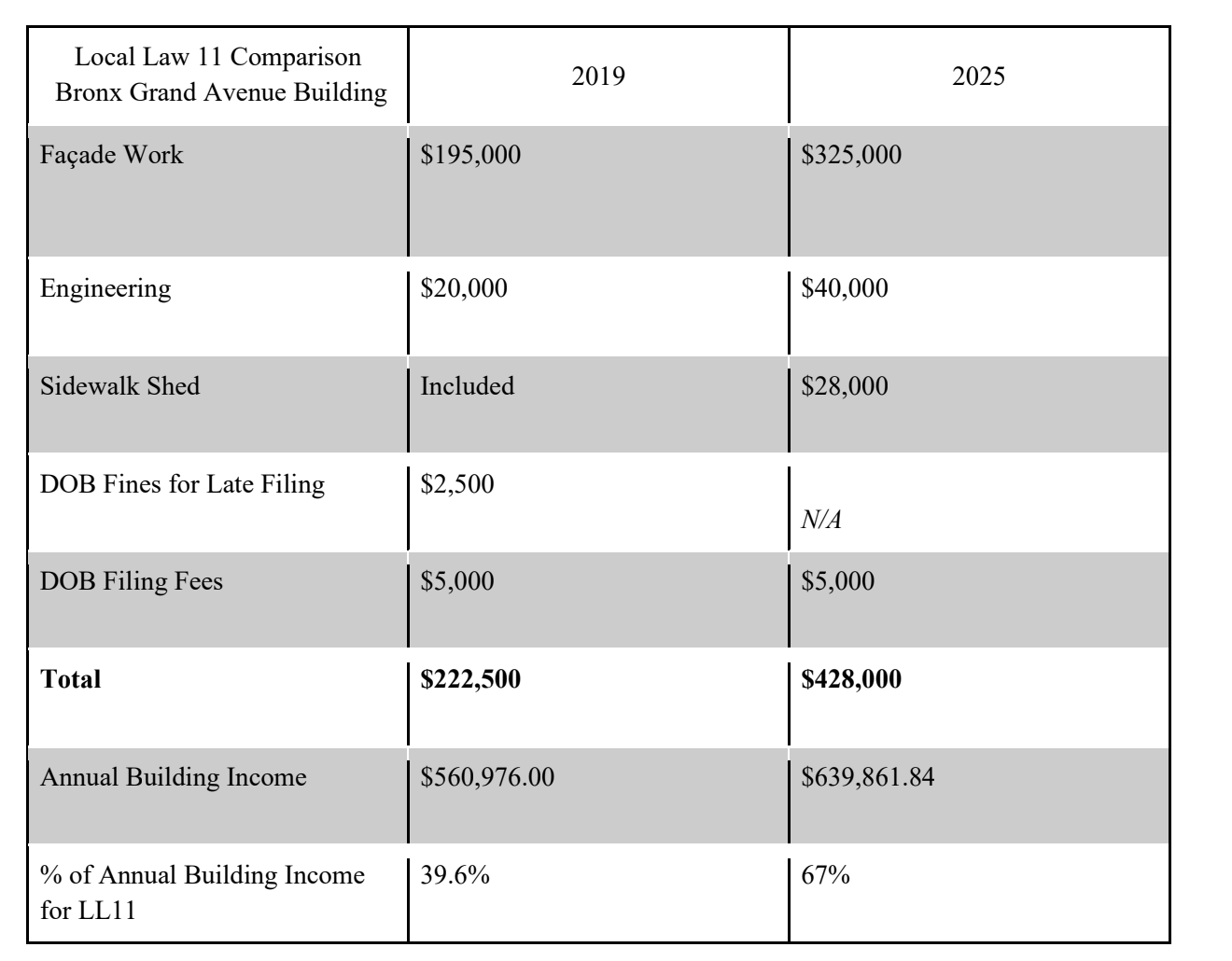
Another area Brendan highlighted is the increasing burden of NYC Local Laws. UNHP has called for revising NYC’s Local Law XI exterior inspection, repointing, and facade replacement requirements to preserve building safety without putting buildings in financial peril, including adjusting the reinspection schedule for compliant multifamily buildings from every 5 to every 8 years. Maintaining exterior walls is critical to public safety, but the cost of complying with Local Law 11 on a five-year cycle creates a budgetary stranglehold that prohibits flexibility to address other capital-intensive needs. The chart below shows the cost of complying with LL11 in 2019 and again in 2025. In 2025, 67% of the annual building income was spent on Local Law 11 compliance. The new administration extended the compliance period to every 6 years, but UNHP would like to see it moved to 8 years.
This paints a clear picture of the conundrum that multifamily affordable housing operators contend with in today’s market. And it’s not just us! In UNHP’s latest report, Every Nickel Counts, we collaborated with 10 different Bronx-based affordable housing operators who all call for practical measures to reduce operating costs, such as increasing funding for the Multifamily Water Assistance Program and immediate relief for affordable housing through insurance subsidies.
We were honored to be joined by HPD Commissioner Dina Levy, who shared some of the new administration’s plans to preserve affordability and reduce distress levels in affordable housing properties. She provided a brief overview of the City’s housing plan, Block by Block, highlighting the City’s intention to preserve and stabilize 200,000 existing homes over the next 10 years and provide $2 billion in City capital funds for preservation programs across FY 2027-2028. These expansions would be achieved through City-backed programs, including the new Supportive Housing Rehabilitation program and Participation Loan Program.
Levy also explained how the City plans to ease the financial burden faced by affordable housing operators. Importantly, she unveiled the City’s plans to invest $100 million in a new, alternative insurance program which will launch in 2027 and expand to 100,000 affordable and rent-stabilized homes by 2030. On the utilities front, the new administration has pledged to expand the Multifamily Water Assistance Program to up to 75,000 units for FY 2026 and 2027. Despite the many financial constraints plaguing the affordable housing sphere, UNHP is encouraged by the City’s efforts to improve and preserve affordability.
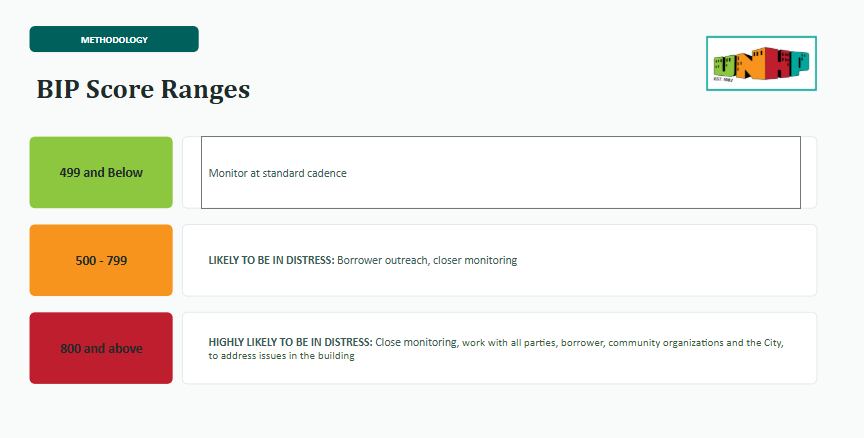
Ultimately, these meetings promote crucial dialogue and collaboration and help demystify the complexity of BIP data. Put simply, BIP scores determine the probable level of distress in multifamily affordable properties. Scores below 500 are deemed not likely to be in distress, while scores between 500-799 are likely to be in distress. Finally, a score of 800 or above signifies that a property is very highly likely to be in distress and stakeholders should take action to address deteriorating conditions.
While BIP scores are rather intuitive, the BIP database itself is a very complex machine, which can sometimes delay reporting. As Ana puts it, “our timeline is only as fast as the slowest source we depend on.” Because the BIP relies on public information, BIP data can only be produced as quickly as publicly available information is, well, made available to the public! BIP data also reflects the information that agencies published the day that UNHP pulled it, not necessarily live information that accurately reflects what is true of properties at this very moment. This leads us to the final point: creating the BIP report sometimes requires manual processes to ensure the data is current and accurate.
Thank you to the lenders who joined us on August 5th for UNHP’s 20th Multifamily Lending Roundtable Meeting. We will continue streamlining BIP processes to deliver vital distress data that can accurately identify and address distressed multifamily housing across the Bronx and NYC.