


Every Nickel Counts: UNHP’s Latest Effort to Preserve Affordable Housing
Affordable housing in New York City is under real strain and the pressure is building.
Across the five boroughs, affordable housing operators are facing mounting financial distress and the consequences are serious. Buildings struggle to stay afloat, operators are forced to make impossible financial decisions, and residents feel the impact firsthand. At a time when affordable housing is more essential than ever, the system that sustains it is being pushed to its limits.
That’s why UNHP launched the Every Nickel Counts Campaign, an effort to spotlight the growing challenges facing affordable multifamily housing and to advance practical, achievable solutions.
Grounded in UNHP’s hands-on experience managing a portfolio of 1,216 affordable units, and informed by partnerships with Bronx-based for-profit and nonprofit housing operators responsible for more than 20,000 additional units, this campaign reflects what we experience firsthand. The financial and physical stability of affordable housing is at risk, but there are clear steps that can be taken to improve these conditions in the short and long term for both residents and operators of affordable housing.
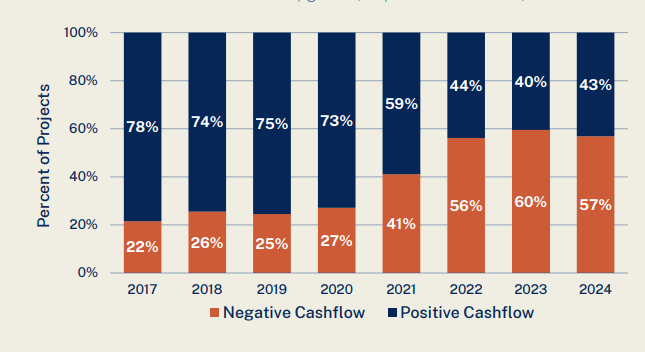
Two citywide reports, one by ANHD and the other by Enterprise/NEF itemized the depth of distress in NYC’s regulated non-profit and for-profit owned multifamily affordable housing stock. Data from UNHP and other affordable housing groups was used in the reports. This graph shows more than half of NY’s affordable multifamily housing has a negative cashflow due to escalating insurance premiums, vacancy delays, increasing operating costs and loss of rental income.
Since the pandemic, buildings have struggled to keep up with operating costs. Skyrocketing utility costs and insurance premiums are the biggest culprits, putting NYC’s affordable housing in jeopardy. On top of everything else, increasingly strict local law requirements have created additional strain during financial periods that already seem insurmountable. Meanwhile, rent collections have declined since the pandemic, creating compounding revenue gap that many properties simply cannot absorb.
UNHP has experienced these realities within its own portfolio, particularly with smaller buildings where operating costs are higher than income, leading to negative cash flows. However, this isn’t just anecdotal. Reports from Enterprise and ANHD confirm that this financial distress is widespread across the city. In an effort to combat this distress, UNHP has worked in collaboration with 10 mission-driven Bronx Building Operators over the last six years to identify key issues and measurable solutions.
Over the past six years, UNHP has worked alongside 10 mission-driven Bronx building operators to better understand the scope of the problem and identify concrete solutions. The Every Nickel Counts: Recommendations to Preserve Distressed Affordable Multifamily Housing report is the result of this collaboration and identification of key issues. The report paves the way for taking measurable actions to achieve attainable results that improve the state of affordable housing in NYC for tenants and management.

This Grand Avenue building is currently undergoing repointing and facade improvements to ensure the building’s safety and compliance with NYC Local Law 11. Every 5 year compliance with these safety standards often places additional financial strain on affordable housing operators who are already struggling to cover operating costs. UNHP recommends extending the timeframe to every 8 years for compliant properties.
Every Nickel Counts: Key Recommendations at a Glance:
- An increase in funding for the Department of Environmental Protection (DEP) Multi-family Water Assistance Program to $100 million from $16.25 million, and doubling the amount per unit to $500.
- Making the one-year HPD waiver on re-rentals permanent based on the successful marketing of vacant apartments under the waiver to interested income-qualifying households in a compliant and timely manner.
- The revision of NYC’s Local Law 11 requirements to preserve the safety of buildings without putting the buildings in financial peril, including adjusting the reinspection schedule for compliant multifamily buildings from every 5 to every 8 years.
- The implementation of a comprehensive strategy to bring insurance costs in affordable housing under control that includes changes in lending, legislative, and judicial processes, coordination efforts by housing agencies to simplify insurance requirements, and provides immediate relief for affordable housing through an insurance subsidy.
- Changes in punitive Con Ed practices around billing and “security deposits” in affordable housing by extending turnaround on payments to a minimum of net 30 days and eliminating shut-off notices for deposit demands and late payments of less than 60 days.
- Reform NYC real estate tax policies to incentivize high-density affordable housing and prioritize distressed affordable multifamily buildings in the use of J-51 and Article XI, 420-c programs.
- Create an Affordable Housing Stability Court as proposed by the New York Housing Conference to connect tenants in need with financial assistance and process cases more quickly

UNHP Every Nickel Counts Report calls for the revision of NYC’s Local Law XI requirements to preserve the safety of buildings without putting the buildings in financial peril, including adjusting the reinspection schedule for compliant multifamily buildings from every 5 to every 8 years. Maintaining exterior walls is critical to public safety, but the cost of complying with Local Law 11 on a five-year cycle creates a budgetary stranglehold that prohibits flexibility to address other capital-intensive needs. This chart shows the cost of complying with LL11 in 2019 and again in 2025. In 2025, 67% of the annual building income was spent on Local Law 11 compliance.
This report details some of the many challenges that NYC’s affordable housing faces and provides recommendations to help alleviate these pressures. We believe the recommendations described here provide a pragmatic way to save on operating costs and restore income flow to distressed affordable multifamily buildings that provide decent homes for lower-income New Yorkers.