


Celebrating 10 years of Savings with the DEP Multi-Family Water Assistance Program (and asking for more money!)
For over 30 years, UNHP has been talking about water and sewer rates and their impact on affordable housing. Our interest stems from vacant building rehabilitation proformas in the late 1980s that projected water and sewer costs well below the actual costs, resulting in a drain on the operating income in year one. The mismatch between projections and actual water costs, combined with the steady and significant rise in rates and inequities that exist in the use of water in lower-income areas like the Bronx, has kept this issue at the top of UNHP’s preservation recommendations for three decades. 10 years ago, the New York City Water Board answered our call by creating a $250 water and sewer tax credit for eligible HPD- or HDC-assisted affordable multifamily housing projects. In 2026, the Water Board has re-authorized the credit program with an even more expansive reach– the original $10 million allocation was increased to $12 million in 2021, and has been increased to $16.25 million, meaning that up to 68,000 apartments can be assisted, vs. last year’s 48,000. Savings from the program have allowed UNHP and the affordable housing sector to reinvest funds into multifamily properties and make improvements for the families who call these buildings home. Our 2021 overview traces UNHP’s decades-long advocacy on water costs and provides links to our published reports.
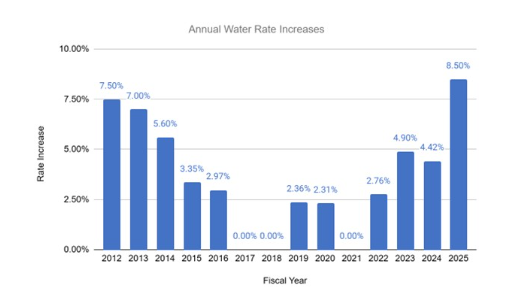
While the rates have been coming down since 2012, it is important to remember that the cost of water has been steadily increasing. The rise in rates since 2022 under the previous mayoral administration’s decision to re-commence collecting a rental payment from the NYC Water Board. This decision resulted in nearly $300 million of the charges collected from ratepayers being sent to the City’s general operating budget. This has contributed to the recent increases in water and sewer charges and has placed the system on a track with projected 7-8.5% increases over the next several years. If there are no changes in policy and anticipated increases in water and sewer charges are realized in the next several years, the cost of water in multifamily buildings in DEP’s Multifamily Conservation Program will be nearing $2,000 per apartment per year in FY2030.
While the recent increase in the Multi-Family Water Assistance program is welcome, UNHP is calling for a larger investment in the face of growing distress in affordable multifamily buildings. Two citywide reports emphasized that rising insurance premiums, water and sewer rates, and utility costs, in tandem with lower rent collections, have created a perfect storm of financial strain. Water and sewer costs continue to rise and are on track to reach a staggering $2,000 per apartment annually by 2030. These pressures have come at a high cost to the affordable housing community, and disproportionately affect low-income families and neighborhoods, with the Bronx standing out as the epicenter. Multifamily water bills disproportionately affect affordable housing and lower-income neighborhoods. The overall rent roll is lower, so the bills eat up a larger portion of the operating budget. Households tend to be larger in areas where lower-income families live. Water costs may also be lower where households are smaller, residents may only live part of the time in their units, use the gym for showers, and take longer and more vacations.
If there are no changes in policy and anticipated increases in water and sewer charges are realized in the next several years, the cost of water in multifamily buildings in DEP’s Multifamily Conservation Program will be nearing $2,000 per apartment per year in FY2030. The larger increases are due to rising capital costs of the water system and the previous mayoral administration’s decision to re-commence collecting a rental payment from the NYC Water Board. This decision resulted in nearly $300 million of the charges collected from ratepayers being sent to the City’s general operating budget. This has contributed to the recent increases in water and sewer charges and has placed the system on a track with projected 7-8.5% increases over the next several years, as shown on p. 43 of the NYC Municipal Water Finance Authority Fiscal 2026 Bond.
Our Building Indicator Project (BIP) shows the impact: water liens increased 126.8% from 2019 Q1 to 2025 Q1, with nearly one-third (32%) of multifamily properties tracked in BIP carrying debt in 2025 Q3. Water and sewer liens account for some of the growth in distress in multifamily rentals.
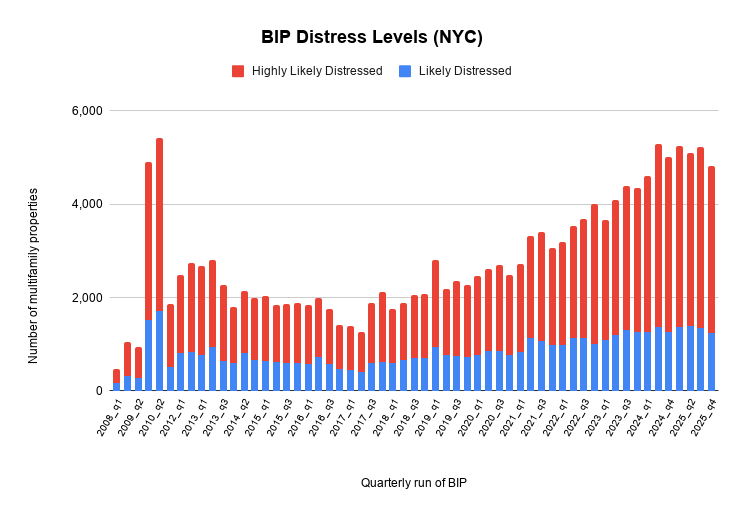
Water liens are one of the indicators that increase the likelihood that a building is in financial distress. Water liens increased 126.8% from 2019 Q1 to 2025 Q1, with nearly one-third (32%) of multifamily properties tracked in BIP carrying debt in 2025 Q3.
The Multi-family Water Assistance Program was implemented in FY 2017-18 and offered a $250 per apartment per year credit towards an eligible building’s water bill. The NYC Water Board and DEP originally allocated $10 million to the program, and in the most recent year, the Water Board increased the allocation to $16.25 million, which means up to 68,000 apartments can be assisted. The Area Median Income (AMI) guideline for the program is 60% of AMI; the program prioritizes projects from lowest to highest AMI; the program is typically over-subscribed; due to the volume of applications, the AMI cutoff last year was roughly 37%. For a building to be eligible, there must be an ACRIS-recorded regulatory agreement with a minimum of 15 years remaining in its restriction period. Additionally, the building cannot owe any money on its water and sewer bill.
With the steadily increasing operating costs in buildings and the sinking Net Operating Income in many of these buildings, we are proposing the following changes in the program:
- Increasing the per-apartment assistance to $500 per apartment (the current $250 per unit has not been increased since the start of the program in 2015, while operating costs and NOI have been declining)
- Increasing the budget of the program to $100 million would allow 200,000 apartments to be included in the program.
- Revising the regulatory agreement term to 3 years.
We are proud to have played a role in the creation of the DEP Multi-Family Water Assistance Program. UNHP has remained steadfast about the importance of addressing rising water and sewer rates and their impact on the affordability of multifamily buildings, with the Department of Environmental Protection and New York City Water Board members acknowledging that UNHP’s research and testimony helped build the case for a credit for regulated affordable housing. UNHP has seen firsthand how the savings from the $250 per unit credit have been invested in affordable units. UNHP and other Bronx affordable housing providers have used the savings from the program to leverage the Con Edison Multifamily Energy Efficiency Program, install LED lighting and insulation, as long-term cost-saving measures that might otherwise have been out of reach.
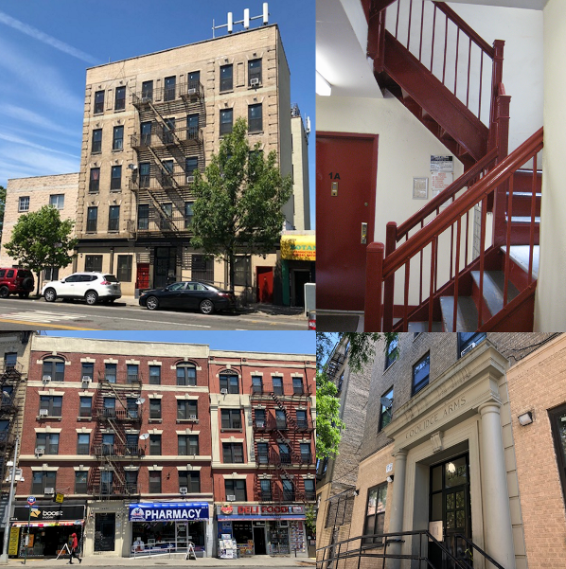
These are some of the Affordable Multifamily buildings that have benefited from the Water and Sewer $250 per unit credit. The credits received were channeled right back into the properties through cost-saving improvements, including LED lighting in public areas and roof insulation.
Check out these reports and blogs for our work on water and sewer rates over the years.
Spring Brings Rising Water Rates and Tighter Budgets, 2014
UNHP Proposes Affordable Housing Cap on Water Rates, 2015
Cost of Water Forum Encourages Discussion about Equitable Water Rates, Conservation & UNHP Rate Cap, 2015
Water Board Approves $10M Towards Credit for Affordable Housing, 2016
10M Water Credit Yields Benefits for Bronx Affordable Housing, 2018
This is What We Do: Research & Action-Seminar on Rising Water Rates & The Threat to Affordable Housing, 2021
UNHP water reports and research:
Affordable Housing Needs Help with Operating Costs -Rising Water and Insurance Costs Threaten Affordability, 2024
Addressing the Ongoing Need for Affordable Water for Affordable Housing, 2017
Affordable Water for Affordable Housing, 2015
Water and Sewer Rate Reform Summit, 2008