


Two Citywide Reports Itemize Affordable Housing Struggles
Despite the bleak news shared in two recently published reports by Enterprise and National Equity Fund and ANHD, UNHP is grateful for the excellent analysis and findings and looks forward to working towards solutions. Both reports use UNHP data and data from other community-based and affordable housing developers to outline the scope of distress in NYC’s affordable multifamily housing and its impact. Data from our multifamily affordable portfolio was used in the jointly-produced Enterprise and National Equity Fund report, analysis of Distress in NY’s Affordable Housing Stock, which reviewed over 400 affordable housing properties. UNHP also shared data on operating costs and rent collections with ANHD as a member of their Community Development Committee, which was part of the analysis in the report, Preserving The Foundation: The Crisis Facing New York Affordable Housing. Both reports highlight the financial distress and need to prioritize the preservation of existing affordable housing that currently provides decent, affordable housing to thousands of low-income New Yorkers, which is at risk. THE CITY and The Gothamist covered the reports in these articles: Rising Costs Threaten Future of NYC’s Affordable Housing, Report Finds, and Affordable Housing’s Slow-Motion Financial Collapse. Both non-profit and for-profit developers are seeing the distress in their affordable housing portfolios. This article in THE CITY highlights the experience of a for-profit developer.
In addition to the unsustainable rise in operating costs, reduced rent collections and delays in renting vacancies contribute to the problem. Jim is quoted in the THE CITY article that covered both the Enterprise/NEF and ANHD reports: “The reports reflect the experience with a portfolio of affordable housing in The Bronx. “We’ve got a lot of things going south at the same time in terms of people’s ability to pay — in terms of the tenants — and substantially rising operating costs,” Buckley said. “The financial problems here ultimately end up translating to problems in the buildings that the tenants will recognize.” In UNHP’s portfolio, ongoing quality and services have yet to be affected as rent collections are almost back to pre-pandemic levels, and the delays in rent-up caused by the Housing Connect quagmire have been resolved at least temporarily by an HPD waiver. The margins are still very slim, and an unexpected major repair or a return to delays in renting vacancies will jeopardize affordability and habitability.
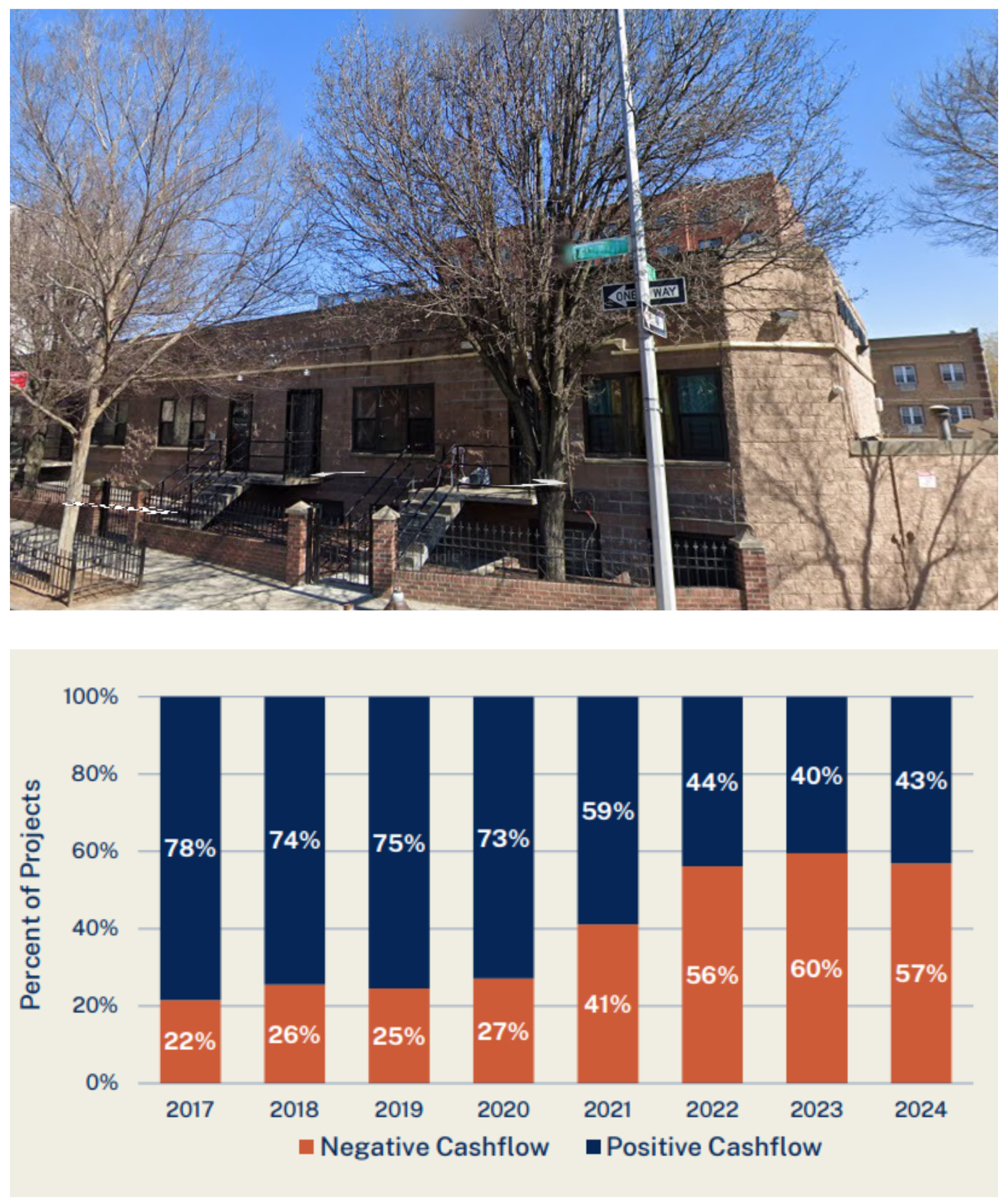
Enterprise and the National Equity Fund’s report analyzed 428 developments with 37,130 apartments, where rents are capped and where building owners receive funding from government sources. The report showed negative cash flow in over 50% of the buildings in the past three years. While most UNHP projects have dwindling but positive cash flows, the smaller buildings are struggling. Pictured above is an 18-unit affordable property initially built in 1989 with 421a tax credits. This property, like the many others detailed in both the ANHD and Enterprise/NEF reports, has a negative cash flow.
The ANHD Preserving the Foundation report focused on the affordable multifamily buildings developed at least in part with public funds by community development corporations and nonprofit groups in NYC. The ANHD report also cites rising operating costs, especially insurance, as jeopardizing an important component of NYC’s affordable housing stock. The drop in rent collections since the pandemic is also cited, noting that even as rent collections improve, the arrears incurred have drained the reserves of many properties. The neighborhoods most at risk are those with the biggest share of subsidized housing and home to tenants with the lowest incomes and highest rent burdens. ANHD’s report cites this, stating “The Bronx emerges as the clear epicenter, with districts such as Morrisania/Crotona, MottHaven/Melrose, Fordham/University Heights, and Highbridge/Concourse reporting some of the lowest household incomes and highest rent-burden and overcrowding rates in the City.”

Bronx AHORA provides a space for frustrated housing seekers to voice their concerns and get in-depth affordable housing information from credible sources. In October, Bronx AHORA met with the HPD Commissioner, Ahmed Tigani, and the New York City Department of Housing Preservation and Development (HPD) via Zoom. HPD is seeking to change the re-rental process on Housing Connect. Bronx AHORA seeks an easier application process and deeper affordability in new construction.
UNHP also understands the financial crunch faced by Bronx families. While affordable housing properties are struggling, tenants are struggling too. The Northwest Bronx Resource Center (NWBRC) works to build financial stability and housing security through our free bilingual programs. Many Bronx residents come to the NWBRC because they are behind on their rent or are looking for a more affordable apartment. In 2022, UNHP brought together program users who were frustrated by their affordable housing search on Housing Connect. The group called Bronx AHORA joined community developers in November of 2023 at a promising meeting with our Council Member, Pierina Sanchez, who has since sponsored legislation to improve the Housing Connect process.
While Bronx buildings are included on the housing lottery, they often require incomes above the median household income of the individuals and families the NWBRC assists, around $35,000. A Bronx AHORA member noted her frustration with the process– “Don’t say it’s affordable housing for low income –It is bogus. You know how many years I have been applying, and I always get turned down because of my income. My income is too low. Ok, then why do you call it affordable housing, for who? It doesn’t make any sense.”
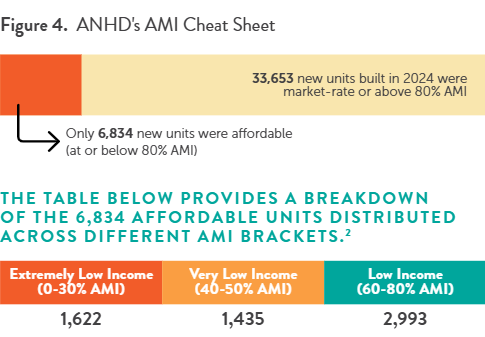
This graph from ANHD’s ‘Preserving the Foundation’ report points out that the development of new units is not meeting the needs of low-income families, as only 6,834 units were built for affordable housing. UNHP concurs that City policy and resources should prioritize the preservation of existing affordable multifamily housing developed by mission-driven operators.
In addition to the difficulty and frustrations with the online NYC affordable housing lottery, the lack of true affordability in new construction is the major complaint of the Bronx housing seekers who are part of Bronx Ahora. As seen in the above ANHD graph, most new units target market-rate tenants or individuals and families with an 80% AMI– $129,600 per year for a family of 4 or more. This leaves few options available for low-income residents in search of housing. Brendan Mitchell, director of real estate at UNHP, is quoted in a The City article about the fragile state of affordable housing in NYC, “The units being created through new construction or through any new development projects are a fraction of what’s existing out there and are at risk of sort of failing. If there’s a triage of what to focus on, it’s the units that are already out there, housing families.”
Thank you to ANHD and Enterprise, and NEF for compiling and analyzing the data that demonstrates the level of risk faced by community developers and, most importantly, to the potential loss of needed, truly affordable multifamily rental units. Patrick Boyle, Enterprise’s senior policy director states the issue well in the press article “We are at a pivotal moment for New York City’s affordable housing stock,” said Patrick Boyle, “The fact that a number of prominent affordable housing organizations are urgently elevating issues around distress in our affordable housing stock right now should signal to policymakers that we need solutions imminently.” UNHP looks forward to working with our community and partners to devise, create, and support solutions